
The Urgency of Lead Response in Senior Care
Lead Response, Senior Care, Operations
TALKING POINT: The 5-Minute Window Is Closing
At 3:47pm, Sara Guida watched a missed call notification slide across her screen. She was in a care conference, the team was short-staffed, and the number was unfamiliar. She let it go. By 4:12pm, she had forgotten it. What she didn’t see was the daughter on the other end, already dialing the next community on her list.
Months later, looking back at occupancy reports, Sara realized something simple and painful: the call you missed at 3:47pm is the tour you won’t know you lost. There is no alert for that. No red banner. Just a quiet, compounding drag on occupancy and caseload.
The 5-minute cliff
Across industries, the pattern is brutally consistent. In the classic Lead Response Management Study, organizations were found to be 21 times more likely to qualify a lead if they responded within 5 minutes versus 30 minutes (InsideSales). Follow-up research in real estate, insurance, and automotive keeps repeating the same story: whoever responds first, fast, usually wins the relationship.
Yet most teams still operate on a scale of hours and days. B2B benchmarks show median response times around 42–47 hours, with many inquiries never answered at all. The math is blunt: the market rewards 5 minutes; operations are built for 48 hours.
Why this matters more in senior care
In senior care, the gap between inquiry and response is not just a sales metric. It is occupancy, acuity mix, and staff workload. Families are usually contacting you at the point of overwhelm: a fall, a hospital discharge, a caregiver who has hit the wall. They are not browsing; they are triaging.
When that daughter calls at 3:47pm and reaches voicemail, she does not wait to see who calls back tomorrow. She calls the next community. Facilities that respond in minutes convert that urgency into scheduled tours and move-ins. Facilities that respond in hours convert it into empty rooms, unstable census, and nurses carrying heavier caseloads than they should.
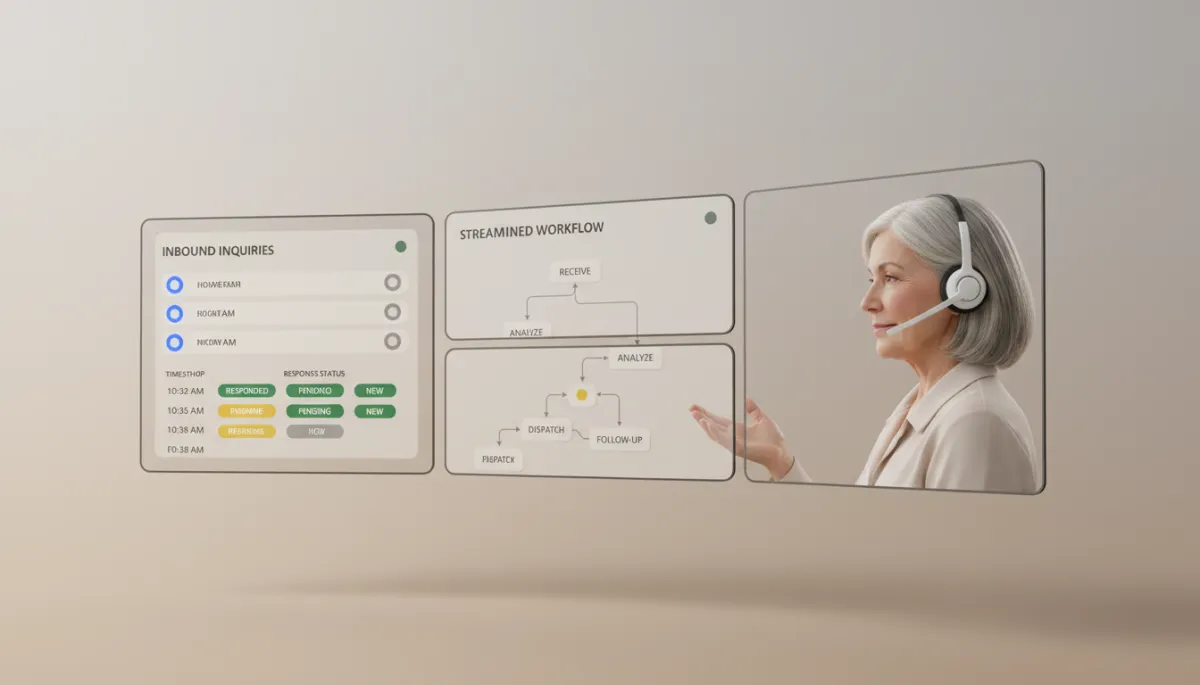
When response becomes a system, occupancy stabilizes and staff load follows.
Sara’s realization: this is not a people problem
When Sara finally pulled the data, she saw patterns her team could not see from the floor. Inquiries coming in during medication passes, shift change, or care conferences sat the longest. Those same time blocks lined up with tours that never materialized and prospects that “went with another option.”
Her staff cared deeply. They were not lazy or indifferent. They were over-tasked and under-instrumented. The problem wasn’t motivation; it was missing infrastructure. There was no reliable way to ensure that the first 5 minutes after an inquiry were protected, no matter what else was happening in the building.
SilverCore as infrastructure, not another app
This is the gap SilverCore is built to close. Not as another dashboard to check, but as infrastructure that quietly guarantees a response inside that 5-minute window, every time, across channels.
Capture: Every inquiry—phone, web form, chat, referral—lands in one queue with a precise timestamp.
Route: Rules push that inquiry to the right human or automated responder in seconds, not hours.
Respond: If your team is tied up, SilverCore still engages: acknowledging the inquiry, asking a few key questions, and securing a next step.
The goal is not to replace human connection. It is to protect it. By making sure every family is met with speed and clarity, you turn an invisible operational leak into a predictable, measurable system.
Designing for occupancy, not hope
Senior care occupancy is often discussed in terms of marketing spend, referral sources, and brand. Those matter. But underneath all of it is a simpler, more controllable layer: how long it takes you to say “we’re here” when someone reaches out.
The 5-minute window is closing because expectations are rising. In other sectors, AI already responds in under 5 seconds. Families bring that expectation with them. Communities that hardwire rapid response into their infrastructure will see fuller buildings, steadier caseloads, and calmer teams. Those that don’t will keep wondering why tours “just feel slow” this quarter.
Sara’s discovery was not dramatic. It was a spreadsheet, a few timestamps, and a quiet realization: the most important part of the sales cycle happens in the minutes no one is watching. SilverCore exists to watch those minutes for you—and to make sure the call you missed at 3:47pm becomes the tour you actually take next week. Book a demo at silvercore.io