
The AI Agencies That Will Still Exist in Three Years Are Already Doing This Differently
AI Agencies, Managed AI Services, Recurring Revenue
AI Agency Recurring Revenue: Why Managed AI Services Will Outlast One‑Time Projects
Why selling AI as a managed ongoing system instead of a one-time project is the only sustainable AI agency model, and how to transition to recurring revenue before your competitors do.

Build AI Systems Once, Get Paid Every Month
Why managed AI services beat one-time projects for agency survival
Agencies that own AI infrastructure and management build durable, compounding recurring revenue.
By Sara Guida | Founder, SilverCore
The Hook

I have watched the same story play out dozens of times. A sharp agency owner learns to build AI systems for local businesses. They sign a few clients, build the systems, charge a setup fee, hand over the keys, and move on. Business is good for a while.
Then something changes. The pipeline slows down because they need new clients constantly to replace the revenue from finished projects. A client calls because something broke and they do not know how to fix it. Another client's system quietly degraded over four months without anyone noticing, and now the client is frustrated and questioning the value.
The one-time project model works until it does not. And it stops working at exactly the moment the agency owner is most tired of chasing new business.
The agencies I see building something durable are doing the opposite. They build the system once. They stay inside the business as the owner of the AI infrastructure. They manage it, optimize it, and improve it monthly. And they charge for that ongoing management every single month.
That is the managed AI services model. And it is the only model that produces a real, sellable, growing AI agency business in this environment.

Side-by-side comparison of an exhausted solo agency owner chasing project work versus a calm AI...
Project-based AI agencies chase new deals; managed AI agencies grow by retention and recurring revenue.
Key Takeaways
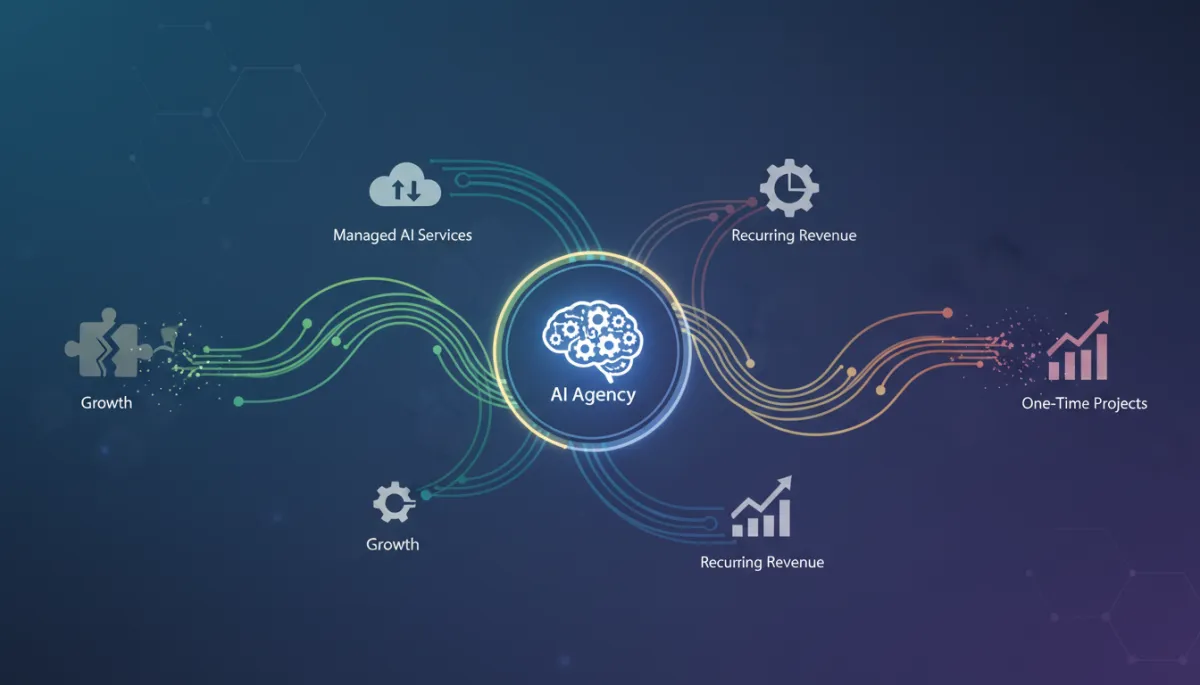
The agency that builds and leaves creates a transaction. The agency that builds and stays creates a business.
Managed AI service providers in technology maintain average client retention rates of 83 to 90%, compared to 20 to 30% for project-based service businesses.
An agency with 20 managed AI service clients at $800/month has $16,000 in monthly recurring revenue, a significantly more valuable and sellable business than an agency doing the same revenue from one-time AI projects.
AI systems require ongoing maintenance, optimization, and updates as platforms evolve. Clients who manage their own systems consistently underperform clients who have professional AI management.
Proprietary data, refined prompts, and institutional client knowledge developed through managed relationships create a competitive moat that cannot be purchased or replicated quickly.
The window for establishing first-mover advantage in managed AI services in most local markets is open now and closing steadily as competitors enter.
The Problem
Here is what the one-time AI setup model looks like from the client's perspective six months after delivery.
The system was great at launch. The agency owner set everything up carefully. Leads were coming in. Follow-up was happening. The CRM was organized for the first time in years.
But then the platform released an update that changed how one of the automations triggered. The client did not know about it because they do not monitor the platform. The automation has been running with a bug for two months. Meanwhile, a better way to write the qualification sequence has emerged, but no one updated the prompts. The content the AI generates is starting to feel repetitive because the content calendar was not designed to refresh. Three leads in the last month were flagged incorrectly as unqualified because the qualification logic was not updated when the client changed their pricing structure.
None of this is catastrophic. None of it will show up in a dramatic failure. It will show up in slowly declining conversion rates, a gradual sense that the AI "does not work as well as it used to," and eventually a decision to try a different solution, probably from someone who offers ongoing management.
This is not a theoretical scenario. It is the predictable end state of every one-time AI deployment that is handed to a client without ongoing management.
The one-time model is not just a business model problem for the agency. It is a service quality problem for the client. And it is why the managed model is better for everyone.
The Evidence
Retention data makes the business case definitively. Research on managed service providers in technology industries consistently shows client retention rates of 83 to 90%, with high-performing MSPs achieving 90% or better. One-time project businesses in the same markets typically see 20 to 30% annual repeat business rates. The economic impact of this difference is compounding: the managed service agency keeps clients while growing, while the project-based agency must replace most of its revenue each year from new sales.
The lifetime value math is the real story. A client who pays $5,000 for a one-time setup has a lifetime value of $5,000. A client who pays $800 per month for managed AI services and stays for 24 months has a lifetime value of $19,200 from the same initial relationship. The lifetime value multiplier for managed services is typically 3 to 6x compared to project-based engagements, which completely changes the economics of client acquisition.
Platform update frequency creates a genuine ongoing service need. The major platforms used for AI business systems, including HighLevel and similar tools, release significant updates multiple times per year. Each update represents both an opportunity and a risk for clients: new capabilities to leverage and new configurations to adjust. An agency that manages five clients' systems stays current with these updates once and applies the knowledge five times. A client managing their own system must keep up individually and rarely does.
The institutional knowledge advantage compounds. Research on professional services retention identifies "institutional knowledge" as one of the primary drivers of client stickiness. When an agency knows a client's business deeply, their messaging, their buyer psychology, their seasonal patterns, their top-performing prompts, that knowledge is genuinely difficult to transfer to a new provider. The managed AI agency accumulates this knowledge over months. It becomes a real switching cost that protects the client relationship.
2025 ScalePad research on MSP business trends found that agencies with managed recurring revenue models were significantly more likely to report business stability, owner satisfaction, and growth confidence compared to agencies dependent on project revenue. The recurring revenue model does not just produce better financial outcomes. It produces a better operating experience for the agency owner.
The Solution
The transition from project-based to managed AI services requires two things: a redefined service scope and a redefined conversation with clients.
The managed service scope needs to answer a specific question for the client: what do you do every month for my money? The answer should include at minimum: monthly platform update review and implementation, monthly prompt optimization based on performance data, monthly performance report with three recommended improvements, monthly check-in call to align on business changes that should affect AI configuration, and unlimited support for issues as they arise.
At SilverCore, we call this the AI Stewardship Model. The premise is simple: we built the system and we own the responsibility for it performing. Not a one-time handoff responsibility. An ongoing, contractual responsibility. When the platform updates, we handle it. When conversion rates slip, we investigate and fix it. When the client's business changes in ways that should affect the system, we update the configuration. The client pays for the outcome, and we manage everything that produces it.
The client conversation shifts from "here is what I will build for you" to "here is what I will own for you." This distinction matters more than any feature set or pricing structure. Ownership implies accountability. It implies that the relationship does not end at launch. It implies that you have a stake in the ongoing performance.
The clients who are best suited for managed AI services are the ones who have already experienced the degradation of a self-managed system, the ones who are too busy to monitor and optimize their own AI infrastructure, and the ones who understand that the system is only as valuable as the ongoing expertise managing it. These clients are not hard to find. They are everywhere. They are the majority of local businesses that have tried AI and been disappointed.
Practical Steps
1. Start by offering managed services to an existing project client.
You already have the relationship, the system knowledge, and the trust. Approach them with a proposal that converts their current setup to a managed service. Position it as "we want to make sure this keeps performing at the level it launched at" rather than an upsell. Price it at 20 to 30% of the original project fee per month.
2. Build a monthly check-in structure before you sign the first retainer.
Define exactly what happens in a managed service relationship each month: what you review, what you optimize, what you report on, and how you communicate results. Having this structure documented before selling it makes the service real and deliverable, not just a billing line item.
3. Create a performance dashboard for each client.
Every managed client should have a simple, monthly performance report that shows three numbers: lead contact rate, lead-to-appointment conversion rate, and pipeline velocity. These three numbers tell both you and the client whether the system is performing. The dashboard makes your value visible every month.
4. Build your pricing around time investment at steady state, not setup.
Once a system is built and running, monthly management typically requires two to four hours per client. Price accordingly: if you want to earn $200 per hour, price monthly management at $400 to $800 depending on scope. Scale up for clients with higher complexity or volume.
5. Document everything you do for each client.
Every prompt change, every configuration update, every platform update applied, every insight generated from the monthly data review. This documentation serves two purposes: it makes your work visible and valuable to the client, and it makes your service deliverable by someone other than you as you scale.
6. Design an expansion menu from day one.
Managed service clients are the most receptive audience for additional services because they already trust you and you already understand their business. Define two or three expansion services, content management, CRM cleanup, additional AI agent deployment, that you can offer as natural next steps when clients are ready.
7. Set a churn response protocol.
Define exactly what you do when a client signals dissatisfaction or requests to cancel. Most managed service churn is preventable if caught early. A monthly performance report that shows positive trends is itself a churn prevention mechanism. Have a defined response plan for when performance dips: first the diagnosis, then the fix, then the communication.
Frequently Asked Questions
How do I price managed AI services?
Most managed AI service agencies price based on the complexity of the system and the expected monthly time investment, ranging from $400 to $1,500 per month depending on scope. A starting point is to estimate your monthly time per client at steady state and multiply by your target hourly rate. Add a margin for platform costs and documentation. The market tends to accept prices in the $500 to $800 per month range for small business clients with standard AI infrastructure.
What if a client does not want ongoing management?
Respect the decision and complete the project well. But include a written summary of what ongoing management would have included and what happens to system performance without it. Many clients who declined managed services initially come back six to twelve months later when the self-managed system has degraded. Position yourself as the natural person to call when that happens.
How many managed clients can one person handle?
At steady state, one experienced managed AI services provider can typically handle 20 to 30 clients with efficient systems. The key is systematizing the monthly review process: using templates for reports, batching the review sessions, and building client documentation that reduces per-client cognitive overhead. The first 10 clients take the most time. The next 20 take proportionally less.
Is there risk that clients will eventually manage their own systems?
Some clients will eventually develop internal capability to manage their AI systems. The best response is to keep advancing your own expertise so you are always offering something they could not easily replicate internally. The agencies that stay relevant are the ones that are always six months ahead of what their clients could do themselves.
How do I generate case studies for this service if I have no managed clients yet?
Start with one client at a significantly reduced price in exchange for documented results and a testimonial. Three months of documented performance improvement from one managed client is enough to begin selling the service to others. Real results, even from a single relationship, are more persuasive than theoretical promises.
The Close
The agency that builds and leaves is always starting over. Every month is a new hunt. Every project end is a revenue gap that needs to be filled.
The agency that builds and stays is always growing. Every client that stays is compounding revenue. Every month of managed service is one more month of institutional knowledge that makes them harder to replace.
The difference is not the service you offer. It is the commitment you make.
You are either managing their AI infrastructure or you are not. There is no middle ground that produces a real business.
Make the decision to stay. Build the system once. Own it permanently. And watch what a recurring model does to the trajectory of your agency.
Sara Guida is the founder of SilverCore, the CRM and growth system built for service businesses where every lead matters. She works with agency owners who want to transition from project-based revenue to managed recurring revenue through AI services. SilverCore exists because the agencies doing the best work for their clients are the ones who never walked away after delivery.