
Boost ROI with AI-Powered Follow-Up Strategies
Lead Generation, Sales Automation, AI Follow-Up
The Leads Are Coming In. The Follow-Up Is Where You Are Losing Them.
Why AI-powered follow-up is the highest-ROI, fastest-payback investment any service business can make right now, and exactly how to build it.

Turn Every Lead Into a Conversation
AI follow-up that responds in seconds, not hours
Instant, consistent follow-up converts late-night inquiries before competitors even see them.
By Sara Guida | Founder, SilverCore
The Hook
It is 9:47 PM on a Thursday. Somewhere in your service area, a business owner just searched for what you offer, found your website, filled out your contact form, and hit submit.
They are motivated. They have been thinking about this for weeks. Tonight, something clicked.
What happens next in your business is the difference between gaining a client or losing them forever to a competitor who never even knew you existed.
For most service businesses, what happens next is nothing. The notification sits until morning. By 8:30 AM, that business owner has already had a conversation with someone else. They do not call to tell you they went with a competitor. They simply disappear, quietly, permanently.
📌 Key Takeaway: The gap between when a lead reaches out and when you respond is one of the biggest hidden revenue leaks in modern service businesses.
This is the most common revenue leak in service businesses today. And it is entirely preventable. Leads are 9x more likely to convert when businesses follow up within five minutes. Responding within an hour instead of immediately can reduce your conversion probability by more than half. Most businesses are responding in hours, sometimes days. A handful are responding in seconds, every time, because AI handles the response before a human ever sees the notification.
AI-powered follow-up is not a nice-to-have. It is the single highest-ROI operational change most service businesses can make. And most businesses have not made it yet.
Key Takeaways
Speed-to-lead is a revenue metric, not a customer service metric. Every hour of delay costs you conversions.
Leads are 9x more likely to convert when followed up within 5 minutes versus 60 minutes.
Responding within 5 minutes versus 30 minutes can increase conversion rates by up to 100x in competitive markets.
Most service businesses respond to leads in hours or days, not minutes. The gap between current practice and optimal practice represents significant recoverable revenue.
A well-built AI follow-up system handles initial response, qualification, appointment booking, and pipeline updates without human intervention.
22% of leads written off as "dead" in CRMs respond to a well-designed AI reactivation sequence, representing substantial recoverable revenue from existing data.
The Problem
The lead follow-up problem is not new. Sales trainers, CRM companies, and marketing consultants have been talking about response time for decades.
What is new is how completely solvable it now is, and how many businesses are still not solving it.
Here is what the problem actually looks like in practice. A lead comes in through a contact form, a Facebook ad, a Google search, an Instagram DM, or a referral text. The business gets a notification. If it is during business hours, it might get addressed within an hour or two. If it is in the evening, on a weekend, or during a busy period, it gets addressed when someone has time.
Meanwhile, the lead is not waiting. The motivated buyer who filled out your form at 9 PM on a Thursday also filled out forms on two other websites in the same search session. Whoever responds first, and with a message that opens a real conversation, owns the relationship. Everyone else is following up to a closed door.
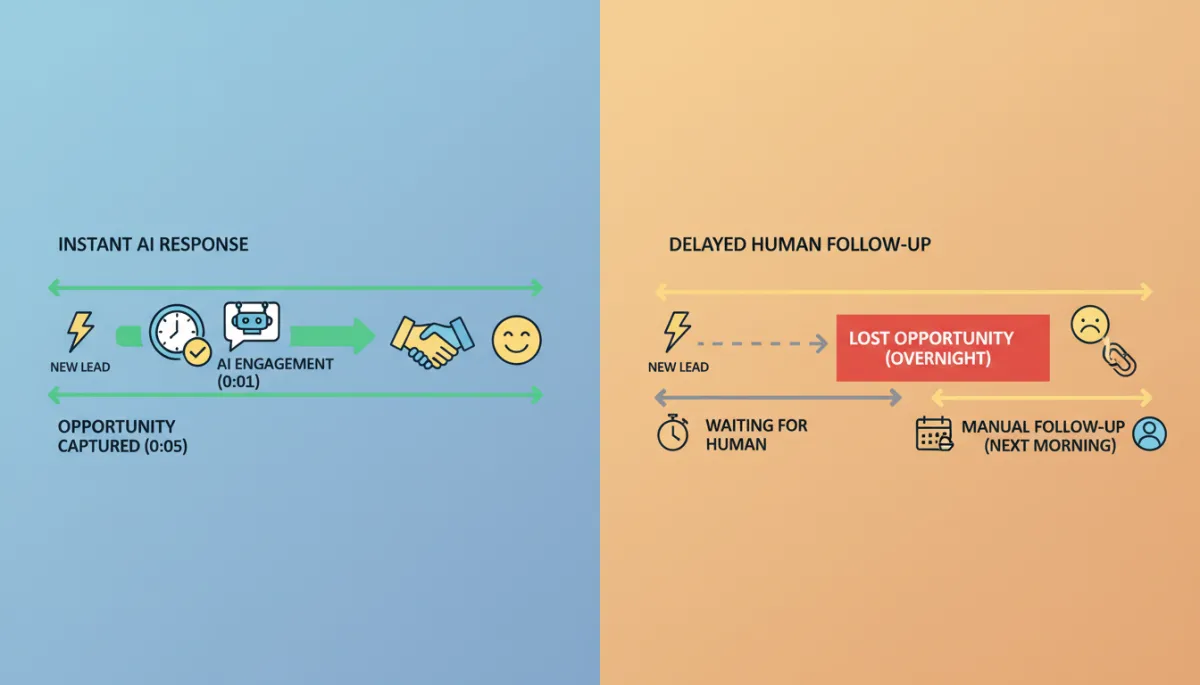
Side-by-side comparison of two timelines, one showing instant AI response to a new lead and the...
The first business to respond meaningfully usually wins the conversation and the contract.
The research is unambiguous on this point. Multiple studies across industries confirm the speed-to-lead effect. The Harvard Business Review analysis found that companies making follow-up calls within one hour of receiving an online inquiry were nearly seven times more likely to have a meaningful conversation with a decision-maker than companies that waited even one additional hour. LeadOwl's research puts the conversion uplift of sub-five-minute response at 400% compared to longer delays.
The businesses still losing this game are not doing so because they do not care about speed. They are doing so because they have not built a system that makes speed automatic. And without a system, speed is dependent on human availability, and humans are not always available.
The Evidence
The speed-to-lead data is only part of the story. The follow-up persistence data is equally important.
Speed matters, but so does follow-up cadence. Research consistently shows that most leads require multiple touchpoints before converting, and most businesses give up far too early. Industry studies suggest that 44% of salespeople give up after one follow-up attempt while 80% of sales require five or more touches. The combination of slow first response and insufficient follow-up is where the majority of service business revenue goes to die.
The 9x conversion increase at 5 minutes is well-documented. The statistic appears across studies tracking automotive, insurance, mortgage, legal, and professional services industries. The mechanism is psychological, not just logistical: the prospect who just filled out a form is in an active state of decision-making. A response that arrives while they are still in that state reaches them at peak motivation. A response that arrives hours later reaches them when they have moved on mentally.
CRM data reveals the magnitude of the problem. Analysis of service business CRM records consistently shows that 60 to 80 days after a lead enters the pipeline, 30 to 50% of those leads are dormant: never properly followed up with, not properly qualified, just sitting in a pipeline that no one is managing. These are leads the business spent marketing dollars to generate. They represent real potential revenue that was created and then abandoned.
AI reactivation results are compelling. SilverCore client implementations of AI-powered lead reactivation sequences, reaching out to leads dormant for 60 to 90 days, consistently show response rates of 20 to 25%. Of those who respond, 40 to 50% schedule a call. For a business with 200 dormant leads in its CRM, that math produces 40 to 50 potential conversations from leads already in the database, at zero additional marketing cost.
The customer support speed parallel reinforces the pattern. A 2025 analysis found that AI-powered customer support systems reduce response times by up to 97% while handling 40 to 60% of inquiries without human involvement. The same principle applies to lead response: AI that handles the first touch allows humans to focus on the conversations that require human judgment rather than spending time on initial contact that could be automated.
The Solution
The AI follow-up system that solves this problem has four components. Each one builds on the last.
Component one: instant first response. The moment a lead enters any contact channel, form submission, ad lead, inbound call, DM, or referral text, an AI-driven first response goes out within 60 seconds. Not an automated "thanks for contacting us" message. A conversational, personalized-sounding first message that acknowledges the specific inquiry, asks one qualifying question, and invites a response. This single component, done well, dramatically improves contact rates and starts the conversation before any competitor has even seen the notification.
Component two: intelligent qualification. Once the prospect responds, the AI conducts a brief, conversational qualification sequence. The goal is to confirm that the prospect is a fit for the business's services, understand their timeline and urgency, and collect the information needed to book a meaningful discovery call. This stage eliminates unqualified prospects from consuming human sales time while ensuring that every qualified prospect reaches the calendar.
Component three: automated booking and pipeline update. When a prospect qualifies, the AI books the call directly to the appropriate calendar without human involvement. The CRM updates automatically. The pipeline stage changes. A confirmation sequence goes to the prospect. The business owner or sales team member sees a booked call on the calendar rather than a raw lead to manage.
Component four: consistent follow-up cadence. For prospects who do not respond immediately, the system maintains a defined follow-up cadence without human intervention. Day one, day three, day seven, day fourteen, each touchpoint automated, each message slightly different in approach, the overall sequence persistent but not pushy. The system continues until the prospect responds, books, or is tagged as non-responsive after the sequence completes.
Practical Steps
1. Audit your current response time today.
Send a test lead through your own contact form and track how long it takes to receive a response. If the answer is more than five minutes, you have a measurable problem with a specific solution. If you cannot test it yourself because you do not know who would respond or when, that is diagnostic information too.
2. Map every channel where leads enter your business.
Website form, Facebook ads, Google ads, Instagram DMs, referral texts, phone calls, Google Business Profile inquiries. Every channel needs to be included in your follow-up system. A lead that enters through a channel your system does not cover is a lead your system did not handle.
3. Write your first response message before you build anything.
The first message your AI sends is the most important touchpoint in the entire sequence. Write it in your authentic voice. Make it specific to the inquiry type. Make it feel like it came from a person who genuinely wants to help. Test it on three people in your target market before deploying it.
4. Define your qualification criteria explicitly.
What makes someone a good fit for your services? What information do you need before booking a call? Write out four to six qualifying questions. These become the qualification sequence your AI runs. The more precisely you define qualification, the better the conversations that reach your calendar.
5. Set up your reactivation sequence for dormant leads.
Pull your CRM and identify every lead that is more than 30 days old with no meaningful follow-up. Run a three-message reactivation sequence over seven days. Do not apologize for the silence. Offer something new, an insight, a relevant case study, a limited-time offer, and make it easy to respond. The revenue already in your database is the most undervalued asset in most service businesses.
6. Build in human escalation triggers.
Define exactly when AI should escalate to a human. High-value prospects over a certain deal size. Prospects who indicate urgency or a specific deadline. Prospects who express frustration or ask to speak with someone. These triggers protect the relationship while keeping the system efficient.
7. Review and optimize monthly.
Track first-response rate, contact rate, qualification rate, and booking rate each month. These four numbers tell you exactly where the system is performing and where it needs refinement. A monthly 30-minute review of these metrics will compound your results significantly over time.
Frequently Asked Questions
Will an automated response feel impersonal to my leads?
A well-written first response that is conversational, specific to the inquiry, and sent immediately does not feel impersonal. It feels responsive. Research consistently shows that prospects react positively to fast responses regardless of whether they know the response was automated, provided the message itself is warm and relevant. The impersonal feeling comes from generic, template-sounding messages, not from automation itself.
How do I handle leads that come in outside business hours?
That is precisely the problem AI follow-up solves. A system that operates 24/7 responds to the 9 PM Thursday lead with the same speed and quality as the 10 AM Tuesday lead. After-hours leads are often the highest-intent leads because the prospect was motivated enough to reach out during personal time. Missing them is particularly costly.
What happens when a lead wants to speak with a human immediately?
Build an escalation trigger that routes high-urgency prospects directly to a human. In the first response message, include a direct option: "If you would rather speak with someone now, here is my direct number." This gives the prospect the choice while the AI handles everyone else. Most prospects are happy to receive a fast, helpful automated response. The option for immediate human contact protects the edge cases.
How many follow-up messages should I send before stopping?
For new leads, a 7 to 14 day sequence with five to six touchpoints across multiple channels, email, text, sometimes a call prompt, is the industry-validated sweet spot. For lead reactivation, three to five messages over 10 to 14 days. After that, archive the lead and move on unless they re-engage.
Can I build this without a large budget or technical team?
Yes. Platforms like HighLevel are designed specifically to allow non-technical service business owners to build complete AI-powered lead response and follow-up systems without developers. The investment is primarily time, spent designing the workflow and writing the messages, not budget or technical expertise.
The Close
Somewhere right now, a motivated buyer in your market is filling out a contact form. They are ready. They have been thinking about this for a while. Tonight, they are doing something about it.
Your competitor's AI is going to respond to them in 47 seconds with a warm, helpful message that asks one smart question and invites a real conversation.
You have a decision to make.
Not about whether this matters. The research settles that question. You have a decision about whether you are going to build the system that puts you in the conversation every time or whether you are going to keep responding in the morning and hoping the lead is still warm.
The lead is not going to wait. Build the system that meets them where they are, when they are there.
Sara Guida is the founder of SilverCore, the CRM and growth system built for service businesses where every lead matters. She works with agency owners, coaches, and service business operators to build AI-powered systems that respond instantly, follow up consistently, and convert more of the leads they are already generating. SilverCore exists because most service businesses are losing revenue not from lack of leads but from lack of a system that closes them.