Reputation Management: Key to Occupancy & Revenue
Reputation Management, Occupancy Strategy, Revenue Optimization
Your Rating Is Your Admission Policy
Stop treating Reputation Management like a vanity metric. In 2026, your Customer Ratings and Online Reviews are quietly writing your occupancy rules, your pricing power, and your revenue ceiling. If you manage space, seats, beds, or bookings, your rating is not a marketing asset—it is an Operational Priority and a hard-number Occupancy Strategy lever.
The Financial Impact: Ratings Are Revenue Math, Not Reputation Fluff
Forbes and Business News Daily have already drawn the line: better Online Reviews drive higher sales and lower acquisition costs. In hospitality and real estate, academic studies show that even a small ratings lift correlates with measurable gains in booking intent and occupancy. When your average score moves from 3.9 to 4.3, you are not just “looking better”—you are buying demand without buying more ads.
Think in blunt math. If a 4.5-star property runs 8–10 percentage points higher occupancy than a 3.5-star competitor—and can hold rate or even charge more—that is a direct, compounding Financial Impact. You pay for poor ratings twice: once in empty inventory, and again in discounting to compensate for lost trust.
📌 Key Takeaway: Every tenth of a star is an occupancy and pricing variable. Ignore it, and you are leaving money on the table every single night.
Your Rating Is Your Admission Policy
Here is the hard truth: your Customer Ratings decide who even considers walking through your digital door. AI-powered search, booking engines, and generative recommendation systems increasingly surface only a handful of options. If your score is below the cut line, you are invisible. Your rating is literally functioning as an admission policy, filtering out high-value guests before your brand ever has a chance to speak.
In this environment, hoping marketing “fixes” perception is delusional. The algorithms are brutal and binary: consistent 4.5+ ratings get surfaced, clicked, and booked. Anything less becomes backup inventory, forced to chase volume with price cuts. That is not a branding problem. That is an Occupancy Strategy failure.
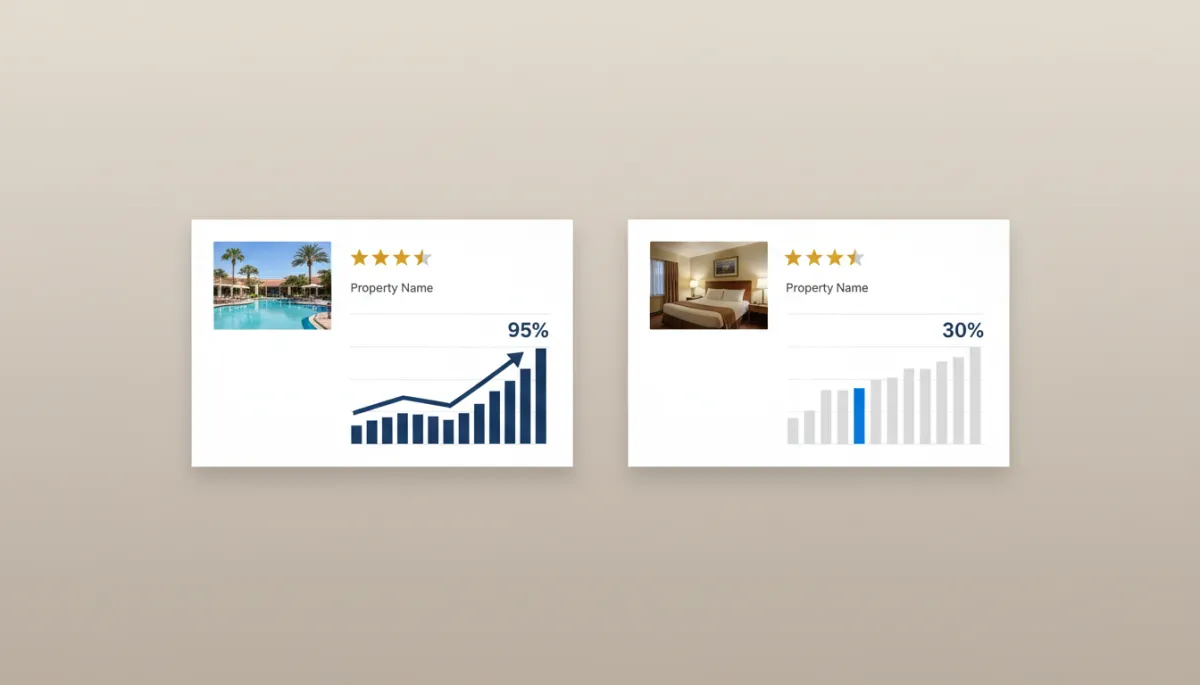
A one-star ratings gap can mean double-digit differences in occupancy and achievable rate.
Reputation Management as an Operational Priority
If your reviews are determining demand, price tolerance, and occupancy, then Reputation Management does not belong buried in a marketing line item. It belongs in your weekly operations rhythm, right beside staffing, maintenance, and revenue management. Leading organizations now treat reputation as strategic capital, tracked in real time at the board level. You cannot afford to be casual where your investors are getting serious.
Make it brutally tactical:
Weekly review audit: Every week, ops leaders review volume, average rating, and sentiment by location, product, or asset—just like occupancy and ADR.
Closed-loop response: Response times, resolution rates, and follow-through on negative reviews are tracked as operational KPIs, not PR niceties.
Root-cause sprints: Recurring complaints trigger process fixes—housekeeping, check-in, maintenance, digital experience—within defined timeframes.
💡 Pro Tip: Treat review metrics like safety metrics—non-negotiable, visible, and discussed in every weekly operations meeting.
Turn Reviews into a Precision Occupancy Strategy
Studies in hospitality show that higher ratings directly influence booking intentions and occupancy rates. Pair that with AI-driven reputation tools that monitor sentiment across text, audio, and video, and you have a powerful control system for demand. Smart operators are already feeding review data into pricing models, staffing plans, and capital allocation decisions.
The playbook is clear:
Measure relentlessly: Link changes in average rating to occupancy, rate, and revenue per available unit across your portfolio.
Model scenarios: Quantify what a 0.2, 0.3, or 0.5 rating lift is worth annually. That is your budget justification for Reputation Management as an Operational Priority.
Execute weekly: Reviews, responses, and fixes are handled on a weekly cadence, not in quarterly campaigns.
If You Manage Occupancy, You Must Own Reputation
SilverCore.io exists for operators who think in occupancy, yield, and risk—not likes and impressions. In that world, Customer Ratings and Online Reviews are core infrastructure. Treat Reputation Management as a weekly, numbers-driven discipline, and your rating becomes a growth engine. Treat it as a soft marketing expense, and your own admission policy will quietly lock you out of the demand you should be winning. Book a demo a silvercore.io