Swipe, Scroll, Repeat: The Science and Psychology of Short-Form Videos
Have you ever opened an app like TikTok, Instagram, or YouTube just to watch a single video, only to look up and realize an hour has magically disappeared? If so, you are definitely not alone. Short-form videos, those quick, bite-sized clips usually under 60 seconds, have completely taken over our digital lives. From funny lip-syncs to life-changing cooking tips, these rapid-fire videos are everywhere.
But why are we so captivated by them? Are they destroying our ability to focus, or is there a deeper psychological reason why we love them so much? Let's take a deep dive into the fascinating world of short-form video content, explore what it actually does to our brains, and learn how both consumers and creators are adapting to this new digital era.
Do you prefer listening to reading? Catch the audio here:
Debunking the Goldfish Myth
First, let's address the elephant in the room. You have probably heard the terrifying statistic that human beings now have an attention span of about eight seconds, which is supposedly worse than a goldfish. Good news: this is a total myth! Researchers and biologists have completely debunked this idea, noting that goldfish actually have great memories, and the original "study" behind the human attention span claim lacked any real scientific proof.
However, the way we focus is shifting. Dr. Gloria Mark, a psychologist who studies digital behavior, found that in 2004, people spent an average of 2.5 minutes focused on a single screen before switching tasks. Today, that number has dropped to an average of just 40 to 47 seconds.
This drop does not mean our brains are broken or that we can no longer pay attention. Instead, it shows that we have developed "attentional flexibility." Because we are bombarded with so much content every day, we have simply become ruthless and highly efficient at filtering out boring or useless information. If a video does not hook us in the first three seconds, we swipe away. Yet, we still have the ability to focus for hours on end when we find something truly engaging, like binge-watching a great television series.
The Psychology of the Scroll: Welcome to the Dopamine Machine
So, what exactly is happening inside our heads when we scroll? Why is it so hard to put the phone down? The secret weapon of short-form video platforms is a brain chemical called dopamine. Dopamine is a neurotransmitter linked to pleasure, motivation, and anticipation.
Apps like TikTok and Instagram Reels are specifically designed to act like "dopamine slot machines". Every time you swipe up, you get a new piece of content. Because you never know what the next video will be it might be hilarious, educational, or surprising, your brain gets a quick hit of dopamine, motivating you to keep swiping in search of the next reward.
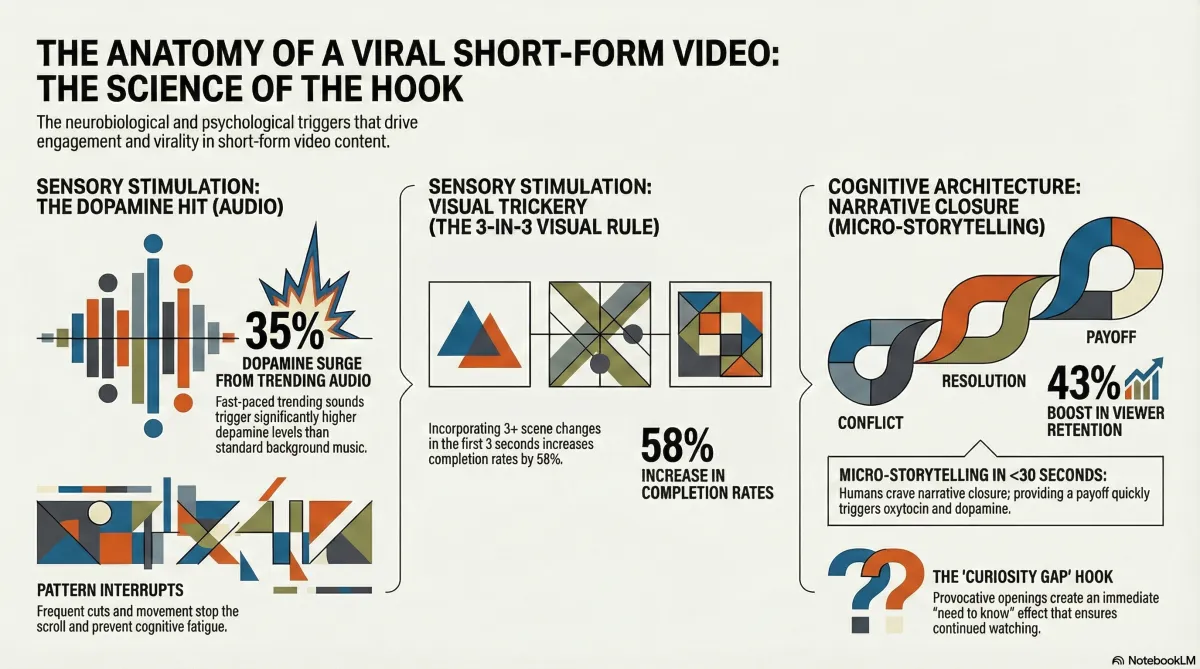
To keep you hooked, creators use three main psychological triggers:
Sound and Music: Fast-paced, trending audio actually causes your brain's dopamine levels to spike 35% higher than regular background music.
Visual Trickery: Bright colors and constant movement keep your eyes locked on the screen. Data shows that videos with three or more scene changes in the first three seconds have a 58% higher completion rate.
Micro-Storytelling: Human beings naturally crave stories. When a short video introduces a problem and provides a quick resolution in just 30 seconds, it gives our brains a satisfying sense of closure.
The Dark Side: "TikTok Brain" and Digital Addiction
While this fast-paced entertainment is incredibly fun, it does come with a dark side. Constantly consuming short-form content can lead to a condition neurologists call "TikTok Brain". Heavy use can literally alter the brain's reward pathways and reduce activity in the prefrontal cortexthe area responsible for impulse control, planning, and deep focus. When the brain gets used to constant, rapid-fire stimulation, slower activities like reading a book or watching a full-length documentary can start to feel boring or exhausting.
This phenomenon is causing real public health concerns, particularly among young adults. Studies analyzing Chinese university students found high rates of short-form video addiction. Researchers discovered that students dealing with emotional distress, loneliness, high stress, or negative childhood experiences are much more likely to use these apps as an escape. Unfortunately, this excessive scrolling can create a vicious cycle, leading to even lower self-control, poorer academic performance, and worse depression and anxiety. To combat this, experts recommend practicing mindfulness, improving time management, and finding a healthy balance between digital entertainment and real-world physical activities.
The Technology Behind the Trend
We also have to thank modern technology for the rise of short videos. A few years ago, trying to watch high-definition video on a cell phone meant dealing with constant buffering and lag. Today, the global rollout of 5G networks has practically eliminated latency. With lightning-fast internet speeds and modern smartphone screens designed for vertical viewing, high-quality video is now seamless and accessible anywhere, whether you are commuting on a train or waiting in line at the grocery store.
Why Brands and Creators Are Going All-In
If you own a business or want to be a content creator, you cannot afford to ignore short-form video. Marketing experts agree that these bite-sized clips offer the highest return on investment (ROI) compared to traditional blog posts or long videos. About 89% of businesses now use video marketing, and short-form is currently the most popular format.
Why do brands love it? First, short-form videos are highly cost-effective and easy to make. You do not need expensive Hollywood cameras; a simple smartphone and an authentic, human personality often perform better than polished commercials. Second, these videos are incredibly easy to share with friends, which increases the chances of a campaign going viral.
Different platforms also serve different purposes for brands:
TikTok: Known as the "Culture Machine," TikTok's algorithm favors raw authenticity and unpredictability. It is the best place to jump on trends and reach a massive, youthful audience.
Instagram Reels: Reels are driven by aesthetics and relationships. They are highly effective for lifestyle content, fashion, and reaching millennials.
YouTube Shorts: Shorts are perfect for long-term discovery because YouTube acts as a massive search engine. Shorts can easily funnel viewers toward a creator's longer, monetized videos.
Finding the Perfect Balance: Short-Form vs. Long-Form
Even though short-form videos dominate our screen time, long-form content is far from dead. In fact, the smartest digital strategy in 2026 is an "80/20 Content Split". Brands use short-form videos 20% of the time as "discovery magnets" to grab a viewer's attention quickly. Once the viewer is hooked, they are guided toward the 80% of long-form content, like in-depth articles, webinars, or 20-minute videos, to build deeper trust and authority.
While short-form video is perfect for a quick laugh or a fast product demo, long-form content is where real relationships are built, and complex topics are fully explained.
Conclusion
Short-form video is not just a passing fad; it represents a permanent evolution in how we consume media. Our brains are adapting to a faster, more visually intense world. While we must be cautious about digital addiction and protect our mental health, we can also appreciate the incredible creativity, humor, and connection these bite-sized clips bring to our daily lives. So the next time you find yourself deep in a scrolling session, at least you will know exactly why your brain loves it so much!
--------------------------------------------------------------------------------
Frequently Asked Questions (FAQ)
Q: Do humans really have shorter attention spans than goldfish? A: No, that is a complete myth! The "goldfish attention span" claim has been debunked by scientists and lacks any biological evidence. While our digital focus on a single screen has dropped to around 40 to 47 seconds, this is because we are simply getting much faster at filtering out content that doesn't interest us.
Q: Why is it so hard to stop scrolling on apps like TikTok or Instagram? A: These apps use a "variable reinforcement" design, much like a slot machine. Because you never know if the next video will be funny or exciting, your brain constantly releases dopamine (a pleasure and motivation chemical) every time you swipe, keeping you hooked in a continuous loop.
Q: What is "TikTok Brain"? A: "TikTok Brain" is an informal term neurologists use to describe changes in the brain's reward circuitry caused by heavy consumption of fast-paced videos. Over time, this constant stimulation can lower activity in the brain's prefrontal cortex, making it more difficult to focus on slower, less stimulating tasks like reading a book.
Q: Should businesses completely stop making long-form content? A: Absolutely not! While short-form videos are amazing for capturing initial attention and going viral, long-form content (like detailed blog posts or longer videos) is crucial for building consumer trust, explaining complex subjects, and boosting search engine optimization (SEO). A healthy mix of both is the most effective strategy.
To Learn more please schedule a call with our Team https://silvercore.io